

Modern organizations generate massive volumes of business data across cloud platforms, CRM systems, ERP software, operational applications, ecommerce tools, financial systems, APIs, and marketing platforms. As analytics ecosystems continue to expand, businesses increasingly face challenges around fragmented reporting environments, disconnected data pipelines, governance complexity, scalability limitations, and delayed decision-making.
For years, organizations relied on separate tools for data engineering, warehousing, transformation, reporting, and visualization. This created operational silos where analytics teams, data engineers, and business users often worked in disconnected systems that required complex integrations and constant maintenance.
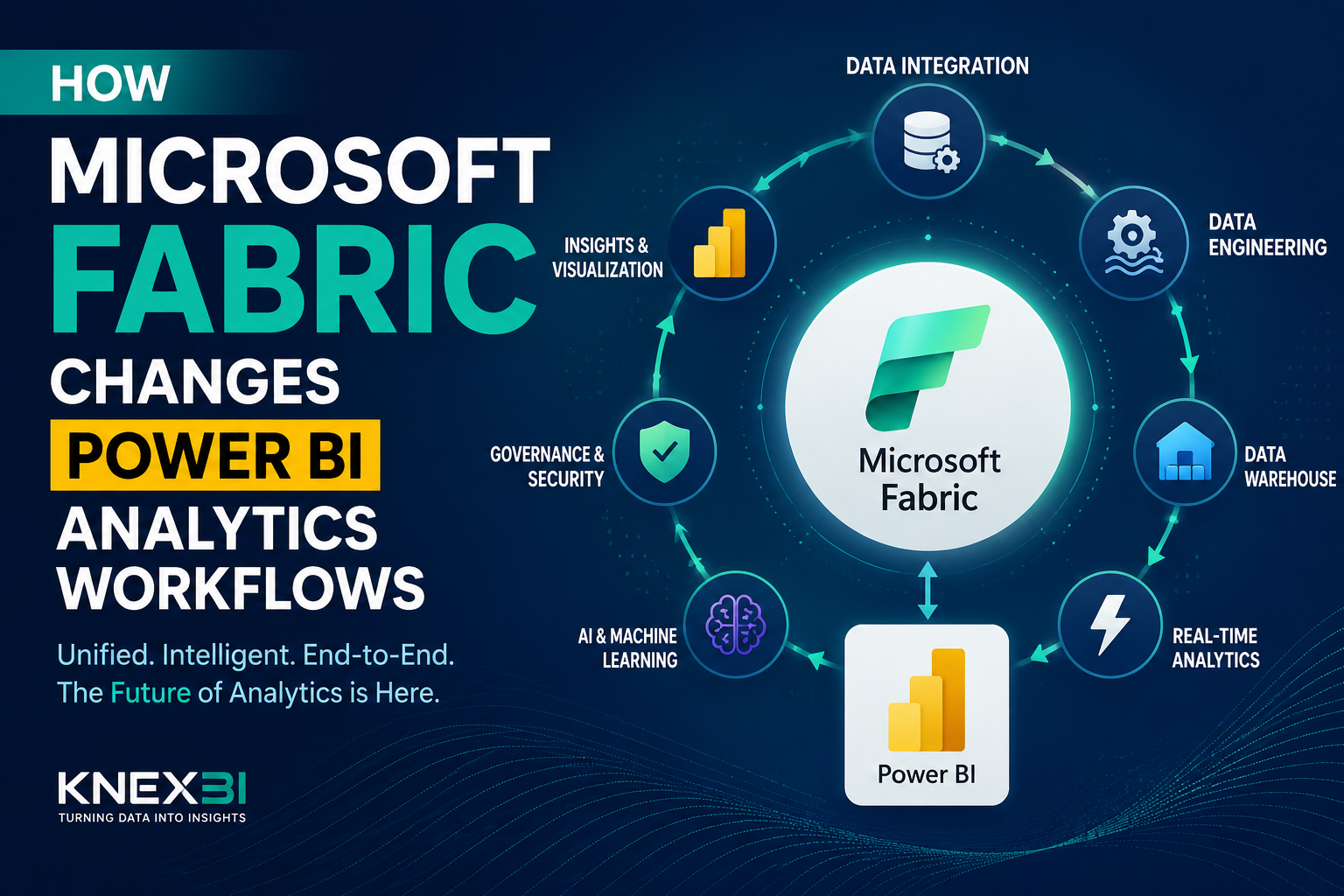
Microsoft Fabric introduces a unified analytics ecosystem that combines data engineering, data integration, warehousing, real-time analytics, business intelligence, and AI-powered insights into a centralized cloud-based environment tightly integrated with Power BI. Instead of managing multiple disconnected analytics systems, organizations can now centralize their entire analytics architecture within a single scalable platform.
Understanding the Traditional Power BI Workflow
Before Microsoft Fabric, Power BI workflows often depended on multiple independent technologies working together across separate environments. A typical analytics workflow usually involved several layers including data ingestion tools, ETL platforms, cloud warehouses, transformation pipelines, semantic models, reporting systems, and visualization dashboards.
For example, an enterprise reporting environment might include:
- SQL databases for operational data
- Azure Data Factory for pipelines
- Synapse Analytics for warehousing
- Separate storage layers
- Power BI for dashboards
- Third-party tools for governance
- External notebooks for data science
Although this architecture supported enterprise reporting, it often introduced operational complexity. Analytics teams regularly faced challenges such as duplicated data movement, disconnected governance workflows, high infrastructure costs, inconsistent KPI definitions, slow reporting pipelines, maintenance overhead, fragmented security controls, and scalability bottlenecks. Microsoft Fabric was designed to solve exactly this problem.
What Is Microsoft Fabric?
Microsoft Fabric is a unified end-to-end analytics platform built by Microsoft to centralize data management, business intelligence, real-time analytics, data science, and reporting workflows into a single integrated ecosystem. Instead of forcing organizations to manage multiple disconnected analytics tools, Microsoft Fabric combines several core analytics capabilities into one centralized environment.
Fabric includes data engineering, data integration, real-time analytics, data warehousing, AI-powered analytics, governance, Power BI integration, and centralized storage architecture. At the core of Microsoft Fabric is the concept of a unified data foundation that allows organizations to work with analytics data without constantly moving information between disconnected systems — creating a more efficient analytics workflow where data engineers, analysts, business users, and leadership teams can collaborate within a shared ecosystem.
How Microsoft Fabric Changes Power BI Workflows
Centralized Analytics Architecture
One of the biggest changes introduced by Microsoft Fabric is the centralization of analytics operations. Traditional Power BI ecosystems often required businesses to manage separate services for data ingestion, transformation, warehousing, semantic modeling, reporting, and governance. Fabric consolidates these workflows into a unified analytics architecture.
This dramatically reduces operational complexity because organizations no longer need to maintain fragmented reporting infrastructures across multiple independent platforms. Analytics teams can now manage reporting pipelines, transformation workflows, business intelligence models, and dashboards within a centralized environment tightly integrated with Power BI.
Power BI Becomes Part of a Larger Analytics Ecosystem
Before Fabric, Power BI primarily functioned as the reporting and visualization layer of the analytics stack. With Microsoft Fabric, Power BI becomes deeply integrated into a broader analytics infrastructure — working alongside Fabric Warehouses, Lakehouses, Real-Time Analytics, Data Engineering environments, AI workloads, and centralized governance systems.
This integration significantly changes how organizations build enterprise business intelligence architectures. Dashboards are no longer isolated reporting assets — they become connected components within centralized analytics ecosystems capable of supporting enterprise-scale reporting operations.
Unified Data Storage Through OneLake
One of the most transformative components of Microsoft Fabric is OneLake — a centralized data lake designed to unify analytics storage across the entire organization. Traditionally, businesses stored analytics data across multiple disconnected systems, creating duplicated storage environments and inconsistent reporting workflows.
With OneLake, organizations can centralize operational data into a shared storage architecture accessible across Fabric workloads and Power BI environments. This reduces data duplication, improves reporting consistency, and simplifies governance because permissions, security policies, and reporting standards can be managed more centrally. For Power BI users, this creates faster and more scalable reporting environments capable of supporting enterprise-wide analytics operations.
Improved Real-Time Analytics Workflows
Modern businesses increasingly require real-time operational visibility. Traditional reporting pipelines often introduced delays because data needed to move through multiple systems before appearing in dashboards. Microsoft Fabric improves real-time analytics workflows by enabling organizations to process and analyze streaming data more efficiently.
Businesses can now monitor operational metrics, customer activity, financial transactions, supply chain performance, marketing campaigns, and system events with lower latency. Instead of relying heavily on scheduled refresh cycles, organizations can create more dynamic reporting ecosystems capable of supporting near real-time analytics visibility. For industries such as ecommerce, logistics, finance, healthcare, and manufacturing, this capability significantly improves operational responsiveness.
Simplified Data Engineering & Transformation
Data transformation has traditionally been one of the most complex aspects of enterprise reporting. Analytics teams often relied on multiple ETL tools, engineering workflows, and transformation platforms before data could reach Power BI dashboards.
Microsoft Fabric simplifies these workflows by integrating data engineering capabilities directly into the analytics ecosystem. Organizations can manage ingestion, transformation, orchestration, and analytics preparation from a centralized environment without constantly moving across separate tools. As a result, organizations can accelerate dashboard deployment, improve reporting consistency, and reduce infrastructure management overhead.
Better Governance for Enterprise Power BI Environments
As analytics adoption grows across organizations, governance becomes increasingly important. Large enterprises often struggle with inconsistent KPI definitions, duplicated reports, unmanaged datasets, uncontrolled dashboard growth, fragmented permissions, and compliance risks.
Microsoft Fabric introduces more centralized governance capabilities that improve analytics management across Power BI ecosystems. Organizations can establish centralized security policies, governed semantic models, standardized reporting environments, unified access controls, and enterprise compliance workflows. This is especially important for businesses operating across multiple departments, business units, or geographic regions where maintaining analytics consistency becomes critical.
AI-Powered Analytics and Copilot Integration
Artificial intelligence is becoming deeply integrated into modern analytics workflows, and Microsoft Fabric accelerates this transition. Fabric introduces AI-powered capabilities that help organizations automate analytics processes, improve reporting accessibility, and enhance business intelligence workflows.
With Copilot integration, users can generate insights faster, create visualizations using natural language, automate reporting tasks, simplify dashboard creation, and improve analytics accessibility. Instead of relying entirely on technical teams for report creation and analysis, business users can interact with analytics systems more naturally through AI-assisted workflows — significantly increasing enterprise analytics adoption.
Faster Power BI Performance & Scalability
Performance optimization has always been a major challenge in enterprise Power BI environments. Large datasets, complex transformations, slow queries, and overloaded semantic models often impact dashboard responsiveness.
Microsoft Fabric improves scalability by centralizing analytics architecture and optimizing how data is stored, processed, and delivered to Power BI. Organizations can build more scalable reporting environments capable of supporting larger datasets, enterprise-wide reporting, cross-functional dashboards, advanced analytics workloads, and real-time monitoring systems.
How Microsoft Fabric Impacts Business Intelligence Teams
Microsoft Fabric is not just changing technology architecture — it is also changing how analytics teams collaborate. Traditionally, data engineers, analysts, data scientists, and business intelligence developers often worked across disconnected tools and operational silos. Fabric creates a more unified environment where teams can collaborate within shared analytics ecosystems.
This improves operational efficiency, reporting alignment, governance consistency, workflow visibility, and analytics scalability. Business users also gain faster access to insights because reporting pipelines become more centralized and automated, allowing organizations to move closer toward fully integrated enterprise business intelligence ecosystems.
Industries Benefiting from Microsoft Fabric
Organizations across industries are increasingly adopting Microsoft Fabric to modernize analytics operations and improve Power BI workflows.
- Retail & Ecommerce: Centralize customer analytics, sales reporting, inventory tracking, and marketing performance dashboards.
- Healthcare: Operational analytics, patient reporting systems, compliance visibility, and centralized reporting architectures.
- Financial Institutions: Risk analytics, forecasting, operational reporting, governance, and real-time financial monitoring.
- Manufacturing: Supply chain analytics, production monitoring, equipment performance tracking, and operational dashboards.
- Technology: Product analytics, customer intelligence, SaaS reporting, and enterprise business intelligence scalability.
Challenges Organizations Must Consider
Although Microsoft Fabric provides major advantages, organizations still need proper implementation strategies. Migrating toward centralized analytics ecosystems requires governance planning, architecture optimization, security frameworks, reporting standardization, semantic model management, and performance optimization.
Without proper planning, organizations may still encounter challenges around dashboard sprawl, reporting duplication, or inefficient analytics workflows. Successful Fabric adoption requires a strong enterprise analytics strategy aligned with long-term reporting goals.
The Future of Power BI with Microsoft Fabric
Microsoft Fabric represents a major shift in how organizations approach business intelligence and analytics architecture. Instead of treating Power BI as an isolated dashboarding tool, businesses are increasingly integrating it into centralized enterprise analytics ecosystems capable of supporting real-time reporting, AI-powered insights, governance, automation, and scalable data operations.
Businesses that invest early in centralized Fabric-powered analytics ecosystems will likely gain advantages in reporting scalability, operational visibility, analytics automation, decision-making speed, governance consistency, and AI-powered business intelligence.
Why Businesses Choose KnexBI for Microsoft Fabric & Power BI Solutions
KnexBI helps organizations build scalable Microsoft Fabric and Power BI ecosystems designed for enterprise analytics, centralized reporting, and automated business intelligence workflows.
- Power BI implementation
- Microsoft Fabric architecture
- Enterprise reporting automation
- Semantic modeling
- Dashboard optimization
- Governance implementation
- Centralized analytics workflows
- Data visualization strategy
- KPI reporting systems
We help businesses transform fragmented reporting infrastructures into scalable enterprise analytics ecosystems capable of supporting modern business intelligence operations.
Summarizing Microsoft Fabric
Microsoft Fabric is fundamentally changing how organizations build, manage, and scale Power BI analytics workflows. By centralizing data engineering, storage, governance, reporting, and AI-powered analytics into a unified ecosystem, Fabric enables businesses to simplify operations while improving scalability, reporting performance, and enterprise business intelligence capabilities.
As analytics environments become increasingly complex, organizations require centralized platforms capable of supporting modern reporting demands across departments, operational systems, and enterprise workflows. Microsoft Fabric represents one of the most important evolutions in modern business intelligence architecture, and its integration with Power BI is reshaping how organizations approach analytics in 2026 and beyond.